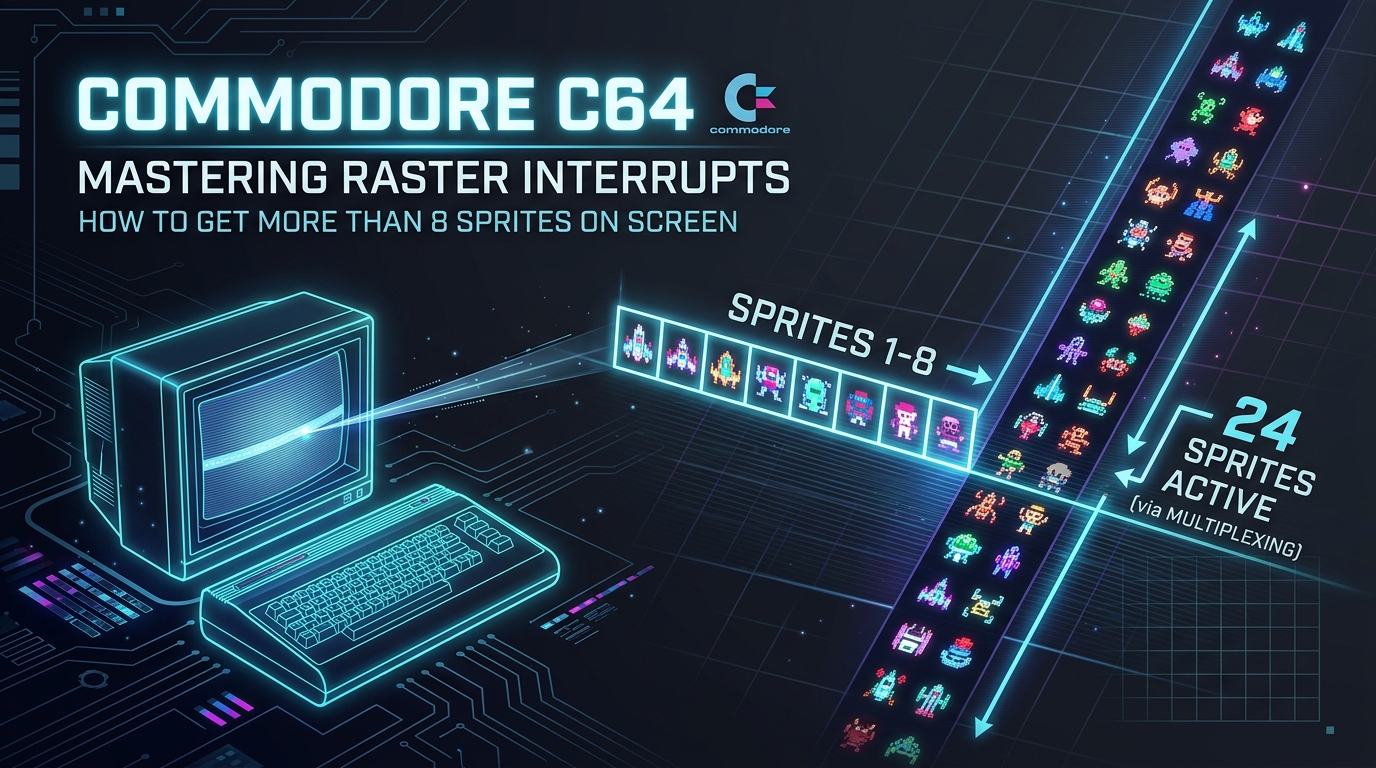
# Mastering the VIC-II: Multiplexing Sprites on the Commodore 64
As a Linux SysAdmin, I spend most of my day managing context switches, process scheduling, and interrupt latency. It is fascinating to realize that the foundations of these concepts were being pushed to their absolute physical limits by bedroom coders in the 1980s.
Today, we’re looking at one of the most iconic “hacks” in retrocomputing: **Sprite Multiplexing**.
On a Commodore 64, the VIC-II (Video Interface Chip) is hardwired to display exactly 8 sprites. If you want more, you have to play a game of “beat the electron beam.”
—
### The Architecture: Why only 8?
The VIC-II chip manages 8 hardware sprite registers. These registers define the X/Y coordinates, shape pointer, and color for each sprite. Once the beam passes the bottom of a sprite, the hardware is finished with it.
To break the limit, we use a **Raster Interrupt**. This allows us to “reprogram” a sprite’s coordinates mid-frame, effectively moving a sprite to a new location before the electron beam draws that part of the screen.
### The Mechanism: Raster Interrupts
In Linux, we think of interrupts as hardware signals forcing the CPU to handle an I/O event. On the C64, the VIC-II can trigger an interrupt when the electron beam reaches a specific raster line.
1. **Wait for the Beam:** We tell the VIC-II, “Hey, trigger an interrupt at line $Y$.”
2. **The Context Switch:** The CPU jumps to our Interrupt Service Routine (ISR).
3. **The Payload:** We update the VIC-II registers (Sprite X/Y) to move the “used” sprite to a new position further down the screen.
4. **The Hand-off:** We set the next interrupt trigger for the next set of sprites.
5. **Return:** `RTI` (Return from Interrupt).
### Conceptual Pseudo-code
If you were writing this in Assembly, your ISR would look something like this:
asm
; — Raster Interrupt Service Routine —
irq:
lda #$30 ; Load the Y-coordinate for the next sprite group
sta $d012 ; Set the next raster trigger
lda #$a0 ; New Y position for sprite 0
sta $d001 ; Update VIC-II register
lda #$b0 ; New Y position for sprite 1
sta $d003 ; Update VIC-II register
asl $d019 ; Acknowledge the interrupt
jmp $ea31 ; Jump to standard KERNAL IRQ handler
### The “Gotchas” (Or: Why your sprites flicker)
Multiplexing isn’t free. As a sysadmin, you’ll recognize these as **race conditions**:
* **The Critical Window:** You have a very narrow time window to update the registers. If your code takes too long to execute (or if another interrupt interferes), you miss the “blanking” period. This results in visual jitter or “tearing” where the sprite jumps between two positions.
* **The Y-Coordinate Limit:** You cannot update a sprite’s Y-coordinate to a value *above* the current raster line. If you try to move a sprite to a line the beam has already passed, the sprite will vanish or glitch until the next frame.
* **Sorting:** To make this work smoothly, you must sort your sprite objects by Y-coordinate. You handle the top-most sprites first, then reconfigure for the ones below.
### Why does this matter?
Modern computing hides these constraints behind abstraction layers, schedulers, and GPU drivers. But the principles remain identical:
* **Interrupt Latency:** If your ISR is too slow, you drop frames.
* **Resource Scheduling:** You are multiplexing a limited hardware resource (8 registers) across a larger set of processes (dozens of sprites).
* **Deterministic Timing:** Much like high-frequency trading or real-time kernel patches (`PREEMPT_RT`), you are chasing microsecond-level precision.
### Final Thoughts
The C64’s VIC-II doesn’t have a “multi-tasking” OS. It is a raw piece of silicon that demands respect. Multiplexing sprites is essentially a manual implementation of a Time-Division Multiple Access (TDMA) protocol.
Next time you’re optimizing a heavy database query or troubleshooting a load spike, remember the humble C64 programmer: they were doing “cloud-scale” resource management, 8 pixels at a time, at 1 MHz.
**Happy Coding!**
Leave a Reply