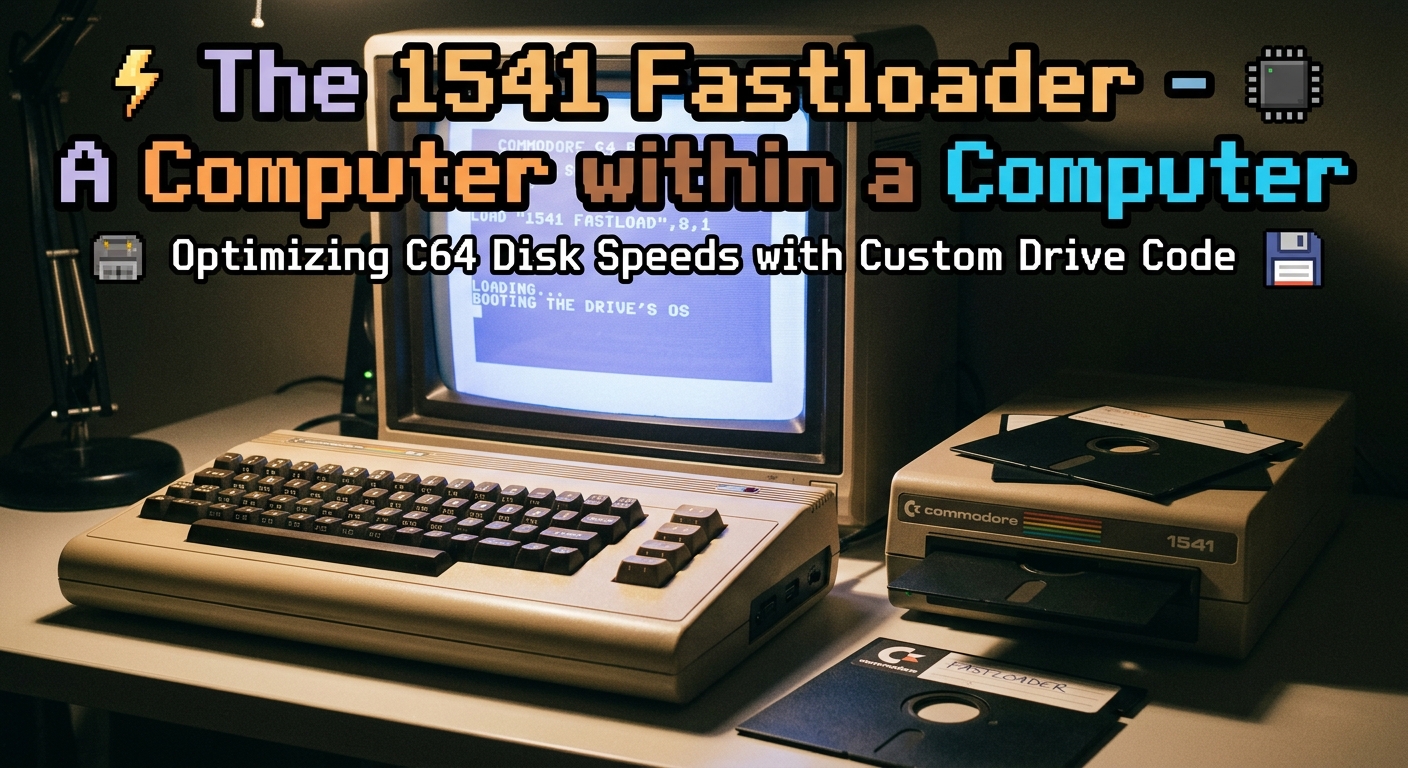
# Beneath the Bezel: The 1541 Disk Drive is a Computer, Not a Peripheral
If you were a sysadmin in the mid-80s, your definition of a “peripheral” likely involved a room-sized mainframe or a bulky terminal. But for those of us who cut our teeth on the Commodore 64, we were introduced to a paradigm shift that still makes modern embedded systems look like amateurs: **the Commodore 1541 disk drive.**
To the uninitiated, the 1541 was just a box that loaded your games. To the engineer, it was a profound lesson in distributed computing. The 1541 wasn’t a “dumb” drive; it was a standalone computer that happened to be attached to your C64 via a serial cable.
### The Hardware Bottleneck: A Serial Bus Nightmare
The C64 utilized the **Commodore Serial Bus**—a proprietary, bit-serial implementation of the IEEE-488 interface. Commodore, in their infinite wisdom (and cost-cutting measures), implemented it in a way that was painfully slow.
In a “vanship” state—using the stock C64 Kernal ROM routines—the serial bus performed at roughly **300 to 400 bytes per second**. To put that in perspective, a modern system administrator would consider that “latency” on a global ping. Why was it so slow? Because the protocol used a complex “handshaking” routine that required constant communication between the C64 and the drive’s CPU, managing line states one bit at a time, with massive overhead.
### The 1541 Architecture: A Computer in its Own Right
Inside that beige, metal-shielded brick sat:
* **A MOS 6502 CPU** running at ~1 MHz.
* **2KB of RAM.**
* **The DOS in ROM** (Disk Operating System).
This wasn’t just a controller; it was a full-blown OS. When you typed `LOAD “*”,8,1`, the C64 sent a command, and the 1541’s internal CPU took over. It parsed the filesystem, managed the head-stepper motor, handled the GCR (Group Coded Recording) encoding, and managed its own error correction.
The C64 was essentially offloading the entire disk management stack to a secondary machine. The problem? That secondary machine was spending 90% of its cycles waiting for the C64 to say “I’m ready for the next bit” and vice versa.
### The “Fastloader” Revolution: Hack the Protocol
Developers quickly realized that the stock serial routines were the bottleneck. The “Fastloader” phenomenon was effectively an exercise in **bypassing the OS.**
To speed up disk I/O, coders stopped using the Kernal routines entirely. They wrote custom machine-code drivers that would:
1. **Bit-Bang the Serial Bus:** By directly manipulating the CIA (Complex Interface Adapter) registers, they ignored the standard handshake.
2. **Synchronous Transfer:** They relied on precise timing loops to send data as fast as the hardware could physically latch it.
3. **Buffer Hacking:** Some loaders even pre-loaded track buffers into the 1541’s meager 2KB RAM, anticipating the next sector request before the C64 even asked for it.
The result? The transfer rate jumped from 400 bytes/sec to **3,000–5,000 bytes/sec**.
### Why this matters to the Sysadmin of today
As a Senior Admin, looking back at the 1541 gives me a deep appreciation for **distributed systems and protocols**. We often take for granted the abstraction layers—TCP/IP, SCSI, NVMe protocols—that handle “read/write” operations for us.
The 1541 taught a generation of programmers that:
* **Abstraction is expensive:** The high-level Kernal routines were safe but agonizingly slow.
* **Hardware/Software synergy is everything:** You couldn’t fix the 1541’s speed without understanding the electrical signal levels of the serial port and the instruction timing of the 6502.
* **Protocol efficiency dictates performance:** The serial bus was inherently capable of much more, but it was being hamstrung by the rules of the handshake.
### The Legacy
The 1541 fastloader was the 8-bit equivalent of writing a custom kernel driver to optimize disk I/O or tuning a TCP stack to handle high-bandwidth low-latency traffic. It was “bare-metal” optimization at its finest.
So, the next time you’re troubleshooting an I/O wait issue on a high-end storage array, remember the 1541. Sometimes, the hardware isn’t the bottleneck—it’s how we’ve chosen to talk to it.
*Keep your registers clean and your interrupts prioritized.*