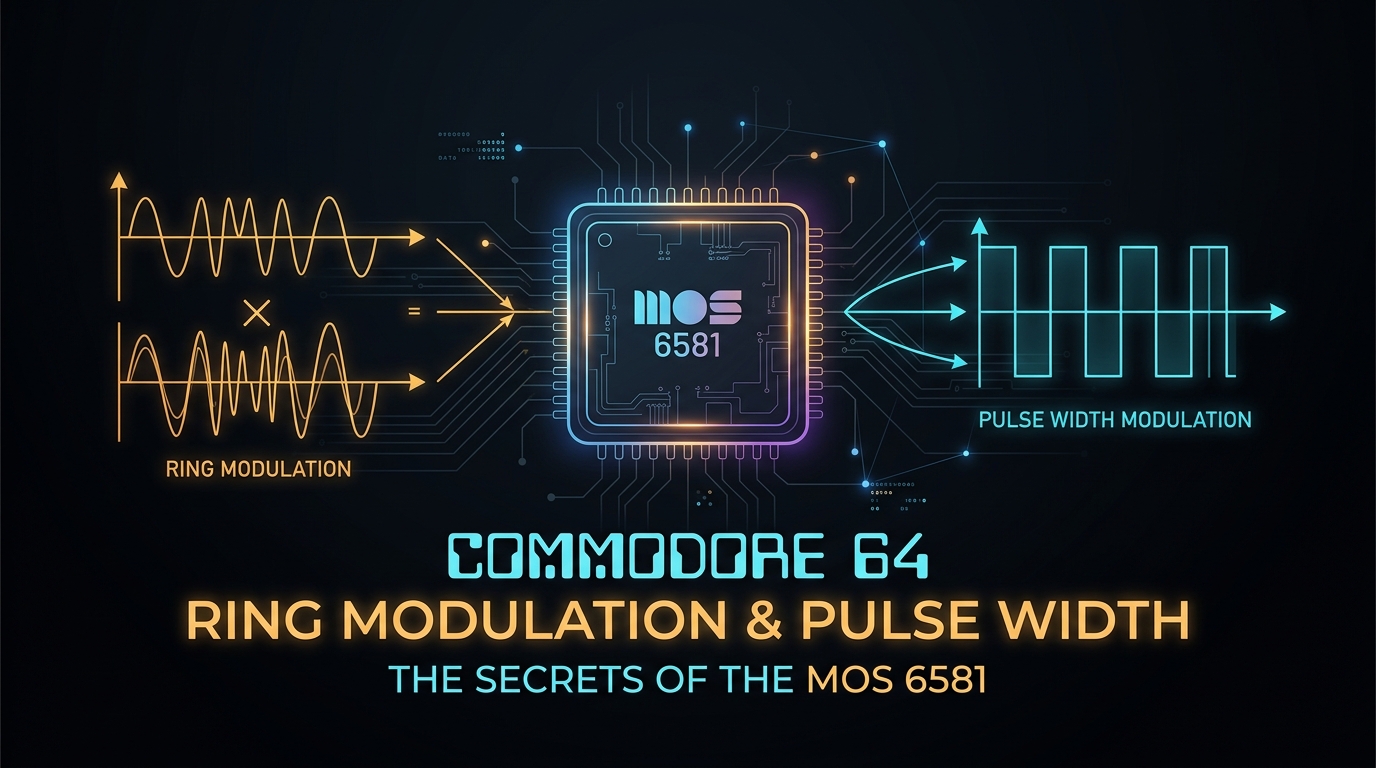
# The Silicon Soul of Synth: Demystifying the MOS 6581 SID Chip
If you’ve spent any time in the trenches of retro-computing or chiptune synthesis, you know that the **MOS Technology 6581 Sound Interface Device (SID)** isn’t just a sound chip—it’s a musical instrument in its own right.
While modern VSTs use high-fidelity samples to emulate the Commodore 64, they often miss the “grit” caused by the physical implementation of the chip’s analog circuitry. Today, we’re going to peel back the layers of the SID to look at two of its most iconic features: **Pulse Width Modulation (PWM)** and **Ring Modulation**.
—
## 1. Pulse Width Modulation (PWM): Shaping the Square
On most synthesizers, a square wave is static. On the 6581, the pulse wave is dynamic. The SID allows you to define the “duty cycle” of the waveform (the ratio of the high pulse to the low pulse) via a 12-bit register (`PW`).
### The Technical “Why”
The SID generates its waveforms using an analog-to-digital-to-analog process. When you adjust the Pulse Width, you aren’t just changing a parameter in software; you are modulating the threshold at which the waveform transitions from high to low.
* **The “Hollow” Sound:** At a 50% duty cycle, you get the classic hollow, woody square wave sound.
* **The “Thin” Sound:** As you deviate from 50% (toward 0% or 100%), the waveform becomes narrower, introducing a rich harmonic structure—specifically, odd-numbered harmonics that give the C64 its trademark “nasal” or “string-like” bite.
**System Admin Tip:** If you’re looking to emulate this in software, don’t use a standard oscillator. You need to model the slight phase-alignment drift that occurs when the SID’s pulse width changes rapidly. That subtle instability is exactly what separates “digital sterile” from “C64 authentic.”
—
## 2. Ring Modulation: The Sound of Chaos
If you’ve ever wondered why some C64 tracks sound like metallic, atonal bell-chimes or aggressive, distorted growls, you are hearing **Ring Modulation**.
In the SID architecture, Ring Modulation is a bit of a “hack.” When enabled, the bit-output of Oscillator 3 is routed to the frequency-control input of Oscillator 1 (or 2). Essentially, the waveform of Osc 3 “chops” the waveform of Osc 1.
### The Math Behind the Madness
Ring modulation is technically **Balanced Modulation**. If you take frequency $f_1$ and modulate it with $f_2$, you don’t get the original frequencies; you get the **sum and difference** ($f_1 + f_2$ and $f_1 – f_2$).
Because the SID’s oscillators aren’t perfectly synced and possess slight analog jitter, the sidebands generated by Ring Mod are often non-integer harmonics. This results in:
* **Atonality:** Perfect for sci-fi sound effects and percussion.
* **Metallic Timbre:** The “Inharmonic” nature of the output mimics the physical vibration of metal plates or bells.
**Pro-tip for Chiptune Producers:** To get that “evil” growl, set Osc 3 to a high frequency (or noise) and enable Ring Modulation on Osc 1. Keep Osc 3’s volume at 0—you only need its waveform cycle to gate Osc 1. This keeps the output clean while maximizing the harmonic distortion.
—
## The “Analog” Reality
The reason the MOS 6581 remains a legend is that it wasn’t a pure digital synthesizer. Bob Yannes (the SID’s architect) designed it with an analog filter and control voltage (CV) elements that leaked, bled, and distorted in ways that were never intended.
When you push the 6581’s filters into resonance, the feedback loop interacts with the digital output stages, causing a nonlinear saturation that modern code struggles to replicate perfectly.
### Why this matters for us?
Whether you’re managing a cluster of servers or composing a soundtrack for a retro-styled project, the MOS 6581 is a masterclass in **constrained creativity**. It teaches us that limitations—be it in hardware throughput or audio synthesis—often force the most ingenious engineering solutions.
**Next time you fire up a C64 emulator, don’t just listen to the music. Think about the transistors flipping, the voltage shifting, and the beautiful, imperfect math happening in the silicon.**
*Keep hacking, keep tuning, and keep the SID alive.*
—
*Questions about bit-banging the 6581 registers? Drop a comment below.*
Leave a Reply