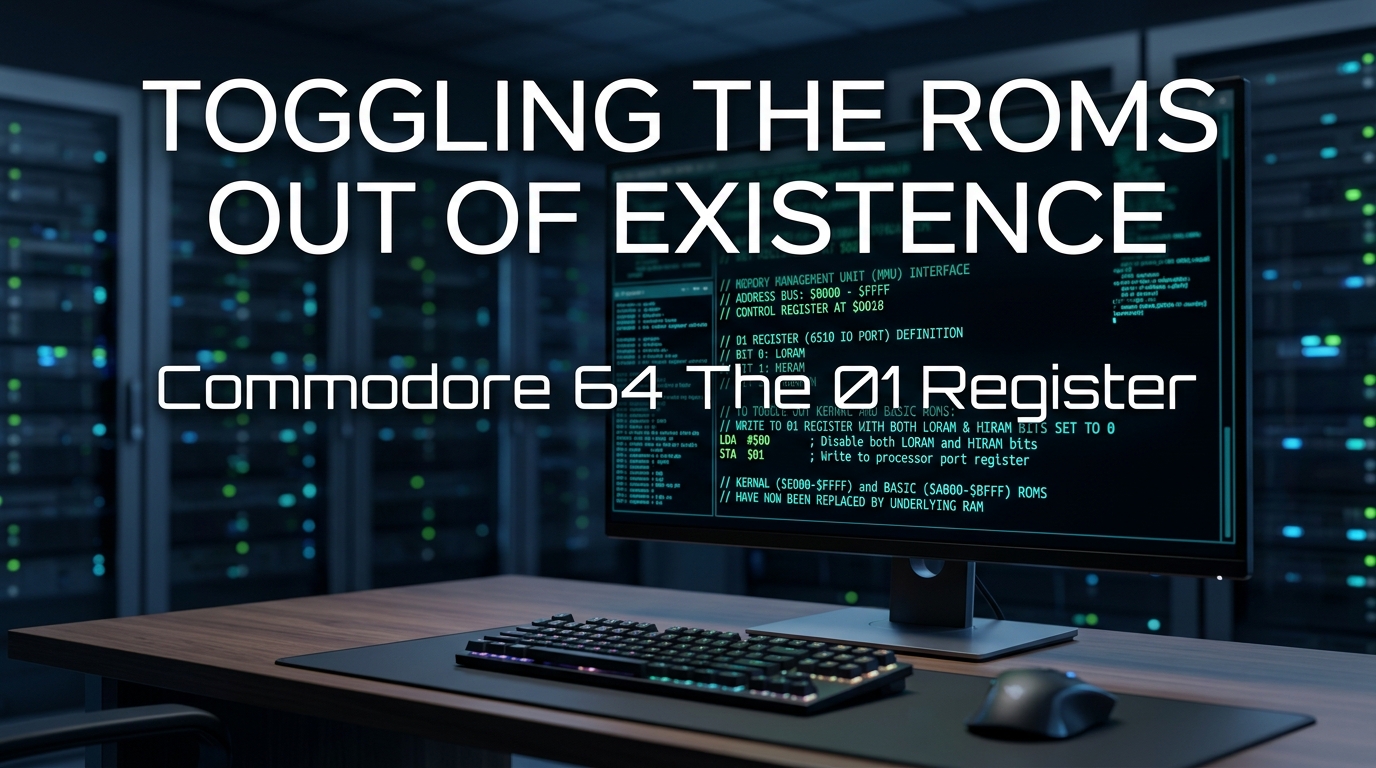
Beneath the Silicon: Unmasking the C64’s $01 Memory Bank Switching
If you grew up in the 8-bit era, the Commodore 64 felt like magic. But as a systems administrator today, looking back at the C64 architecture, it wasn’t magic—it was a masterclass in memory-mapped I/O (MMIO) and hardware-level bank switching.
While modern servers use sophisticated MMU (Memory Management Unit) logic to handle virtual memory, the MOS 6510 CPU in our beloved C64 had a much more “hands-on” approach. The key to unlocking the true potential of the machine lies in a single, unassuming memory address: $01.
Today, we’re going to perform a deep-dive autopsy on how the C64 toggles its ROMs to reclaim precious RAM.
The Problem: The 64KB Paradox
The MOS 6510 CPU has a 16-bit address bus. This mathematically limits it to 64KB of addressable space. In 1982, shipping a 64KB machine meant you had to fit the OS (KERNAL), the language interpreter (BASIC), the character generator ROM, and the I/O registers (VIC-II, SID, CIA) into that same 64KB footprint.
If you map the ROMs to those addresses, you lose the RAM underneath them. You’re essentially “blocking” access to the system memory.
Enter Register $01: The Data Direction Register
The CPU port at address $01 (and its configuration register at $00) acts as a hardware switch. By writing specific bits to $01, you can physically disconnect the ROMs from the address bus and “unmask” the hidden RAM residing beneath them.
The Bitwise Breakdown
The lower three bits of address $01 control the visibility of the ROMs and I/O:
- Bit 0 (LORAM): Controls BASIC ROM visibility ($A000–$BFFF).
- Bit 1 (HIRAM): Controls KERNAL ROM visibility ($E000–$FFFF).
- Bit 2 (CHAREN): Controls Character ROM visibility ($D000–$DFFF).
When these bits are set to 1, the ROM is mapped into the memory space. When set to 0, the ROM is disabled, and the underlying RAM becomes visible to the CPU.
The “Oh Crap” Moment: The Interrupt Vector Trap
As a sysadmin, I’m obsessed with interrupt handling. This is where the C64 architecture gets dangerous.
The CPU uses the top of the memory space ($FFFA–$FFFF) to store vectors for hardware interrupts (IRQ, NMI, and RESET). If you flip Bit 1 (HIRAM) to 0 to disable the KERNAL ROM, you aren’t just turning off the OS—you are turning off the interrupt pointers.
If an interrupt triggers while the KERNAL ROM is banked out, the CPU will look at the RAM beneath the KERNAL for the interrupt vector. If you haven’t copied your interrupt handlers there, the system will crash, usually resulting in a hard lock or a jump into random junk memory (garbage-in, garbage-out).
The Sysadmin Protocol:
Before flipping bit 1 to 0, you must:
1. Disable interrupts (SEI instruction).
2. Copy the interrupt vectors from the KERNAL ROM space into the corresponding RAM addresses.
3. Perform your memory-intensive operations.
4. Restore the KERNAL by setting bit 1 back to 1.
5. Re-enable interrupts (CLI).
Why would you ever do this?
Beyond the “hacker cred,” there are legitimate architectural reasons:
- Massive Data Processing: By banking out the ROMs, you gain an additional ~16KB of usable RAM, bringing your total workspace to nearly the full 64KB. This was essential for high-end assembly programs, compilers, and complex games.
- Custom Kernels: Advanced developers (like those creating GEOS) would swap out the KERNAL entirely, replacing it with custom routines while still keeping the machine hardware-compatible.
- Performance: If you’re writing your own I/O routines, you don’t need the slow, generic KERNAL entry points. Disabling it clears the way for high-speed custom code.
The Code (A Brief Peek)
If you wanted to disable BASIC and the KERNAL to access all available RAM for a high-speed buffer, your assembly would look like this:
lda $01      ; Load current port state
and #$f8     ; Clear bits 0, 1, and 2 (Masking)
sta $01      ; Write back to enable RAM in those zones
Simple, elegant, and lethal if you handle the interrupts wrong.
Final Thoughts
Working with the C64’s memory mapping is the 8-bit equivalent of modifying your init process or recompiling the kernel to remove unused drivers. It’s about stripping away the abstractions provided by the OS to speak directly to the hardware.
While we live in an era of gigabytes of RAM and protected memory space, there is something deeply satisfying about knowing exactly which transistor is being flipped to turn an OS on or off.
Stay curious, and keep your registers clean.