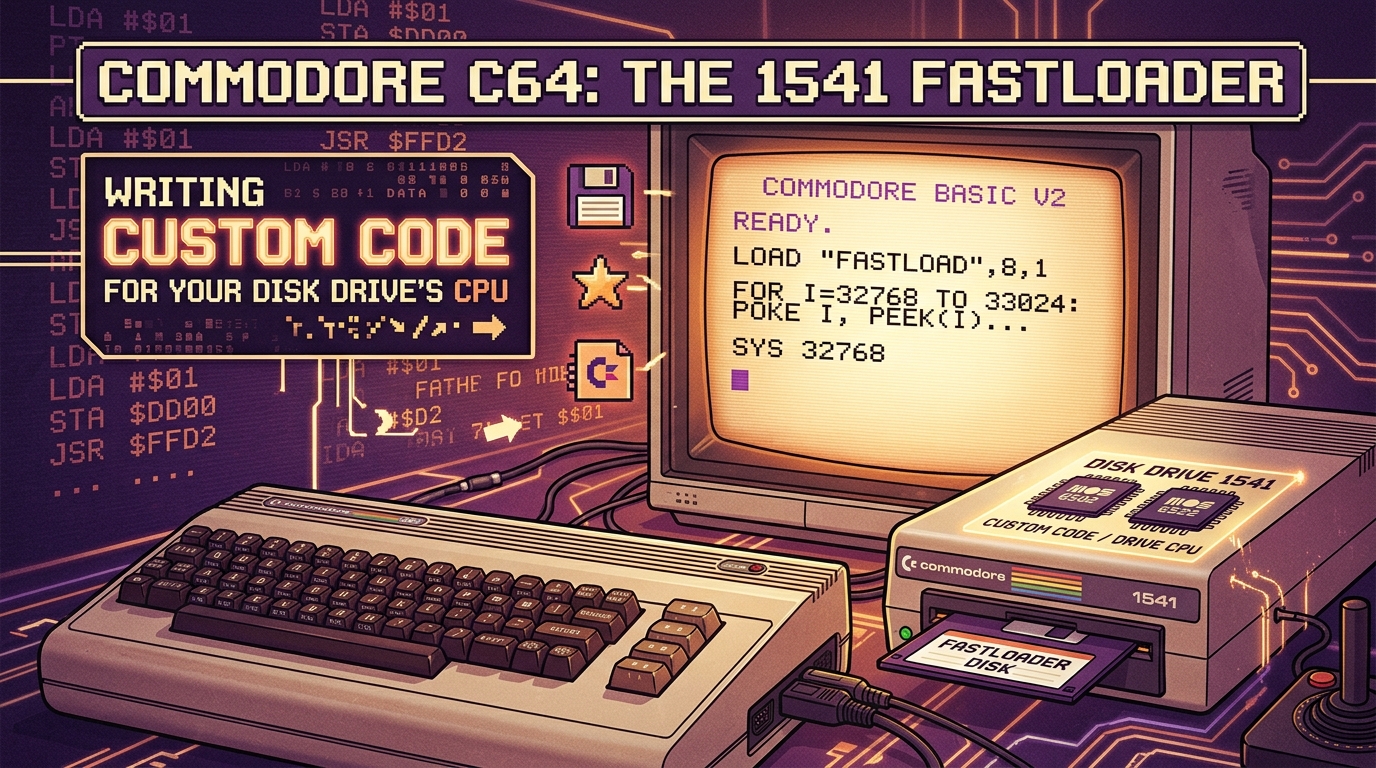
# Under the Hood: Unleashing the 1541 Disk Drive with Custom Fastloader Code
If you grew up with a Commodore 64, you likely share a universal trauma: the agonizing wait for a game to load. The Commodore 1541 disk drive is a marvel of 1980s engineering, but it has a notorious bottleneck—its serial bus communication.
In its “native” mode, the C64 and the 1541 communicate using a bit-banging protocol that is shockingly slow (approx. 400 bytes per second). Why? Because the drive is essentially a full-blown computer (MOS 6502 CPU, 2KB RAM, 16KB ROM) that is forced to spend most of its cycles babysitting the serial port.
Today, we’re going to look under the hood at how developers bypass the stock ROM routines by **injecting custom code directly into the 1541’s RAM.**
—
### The Architecture: A Computer within a Computer
The 1541 is a standalone system. When you command the C64 to `LOAD`, it sends a message over the serial bus. The drive’s MOS 6502 CPU listens, processes the request, and shuffles data from the disk head through its buffer into the serial port.
The stock ROM routine uses a slow, handshaking method to ensure data integrity over the serial line. To speed this up, we need to:
1. **Allocate space** in the 1541’s internal RAM (typically the $0300–$07FF range is fair game).
2. **Upload** a custom binary payload that handles hardware-level bit manipulation.
3. **Trigger** the new code via a jump instruction or an interrupt hook.
### Writing the Fastloader: The “Bit-Banging” Trick
The goal of a fastloader is to use the serial lines (Data and Clock) in a way that minimizes handshaking overhead. Instead of acknowledging every single bit, we shift data in larger chunks or use timed protocols.
Here is a simplified conceptual flow for a custom 1541-side routine:
asm
; Minimal 1541 Fastloader Stub (Conceptual)
* = $0300
sei ; Disable interrupts
loop:
lda $1800 ; Read from disk controller
; … custom timing-sensitive bit shifting …
sta $1800 ; Push to serial port directly
jmp loop
### The Workflow: Injection
You cannot simply “copy” files to the 1541. You must write a “loader” program on the C64 side.
1. **The Handshake:** Your C64 program sends a `M-E` (Memory Execute) or `M-W` (Memory Write) command to the drive to prepare it to receive bytes.
2. **The Blob:** The C64 sends your custom machine code byte-by-byte over the serial bus.
3. **The Activation:** Once the code is in the 1541’s RAM, the C64 sends a jump command to the starting address (e.g., `U0` or `M-E`).
4. **The Takeover:** The 1541 is now running *your* code, ignoring the factory ROM routines. It is now ready to blast data to the C64 at 5x to 10x the standard speed.
### Why This is “System Administration” for Retro Hardware
As a SysAdmin, we are accustomed to optimizing kernel parameters or tuning network stacks for better throughput. Writing a 1541 fastloader is exactly that: **Kernel tuning for a disk controller.**
You are dealing with:
* **Race conditions:** The drive CPU has to read the disk head and write to the serial port simultaneously.
* **Timing constraints:** The serial bus is sensitive to clock skew.
* **Interrupt handling:** If you miss a cycle because an interrupt fired, your data stream corrupts.
### The Legacy
This technique defined the C64 gaming scene. Titles like *The Last Ninja* or *Turrican* weren’t just great games; they were feats of low-level systems programming. Developers like Epyx (FastLoad) and various demo-scene groups pushed the 1541 to its physical limits, sometimes exceeding 3,000 bytes per second.
If you’re interested in trying this, I highly recommend checking out [C64 Wiki](https://www.c64-wiki.com/) for memory maps and looking into the **Epyx FastLoad** source code, which is widely available in historical archives.
**Happy Hacking (and let’s hope your head-alignment is set correctly).**