Behind the Silicon Curtain: Why the Amiga’s Blitter Made the 386 Look Like a Typewriter
If you talk to anyone who cut their teeth on 80s and 90s computing, they’ll tell you: The PC was for spreadsheets, but the Amiga was for living.
While the IBM PC clones of the late 80s were wrestling with the overhead of the MS-DOS interrupt table and hammering the CPU for every pixel moved, the Amiga was doing something fundamentally different. It was architected as a “multimedia workstation” before that term was even a buzzword. At the heart of this superiority lay a custom co-processor that remains a marvel of engineering: The Blitter.
Today, as a Linux SysAdmin, I look back at the Amiga not just with nostalgia, but with genuine technical awe. Let’s crack open the hood and see why the Blitter left the mighty 386 in the dust.
The Bottleneck: The CPU Tax
To understand why the Blitter was revolutionary, you have to understand the “CPU Tax.”
In a standard PC architecture of the era (the 8088, 286, and even the 386), the CPU was the “Manager of Everything.” If you wanted to move a bitmap image—say, a sprite—from memory to the screen, the CPU had to perform the heavy lifting:
1. Load a byte from source memory.
2. Store that byte in destination memory.
3. Increment pointers.
4. Decrement the counter.
5. Loop back.
Doing this in software consumed massive CPU cycles. The more graphics you pushed, the less time the CPU had for game logic, AI, or sound. This is why many early PC games had choppy, “stuttery” movement.
Enter the Blitter: The DMA Specialist
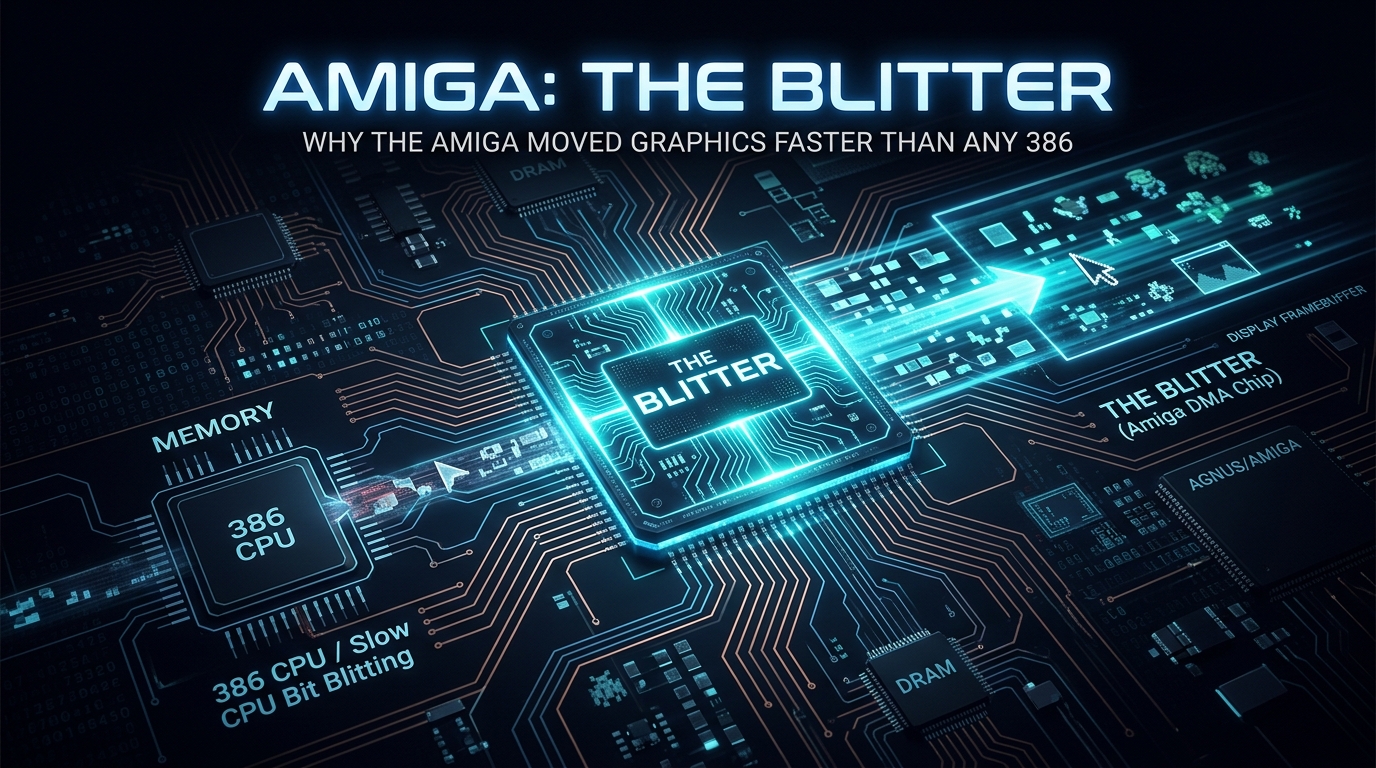
The Amiga’s Blitter (Block Image Transferrer) was a hardware co-processor integrated into the Agnus chip. It was essentially a dedicated DMA (Direct Memory Access) engine designed for a single purpose: Moving blocks of data around memory without touching the 68000 CPU.
The Blitter could perform memory copies, fills, and logical operations (AND, OR, XOR, etc.) at hardware speeds.
1. Zero CPU Overhead
When the Blitter was active, the 68000 CPU could be doing literally anything else. Because the Blitter operated via DMA, it “stole” cycles from the memory bus to perform its operations. While this sounds like a conflict, the Amiga’s architecture was designed so the Blitter and CPU were essentially “hand-shaking” perfectly. The CPU didn’t have to wait for the Blitter to finish; it just fired off a command packet and moved on.
2. The Logic Engine (The “Minterm” Magic)
The Blitter wasn’t just a “move” command. It had a logic unit that could process data as it moved.
* Transparency: By using a logical “mask,” the Blitter could skip copying bits that represented the background color of a sprite. This is how you got transparent characters moving over complex backgrounds without needing a massive CPU-heavy “masking” routine.
* Area Fills: The Blitter could fill a region with a solid color instantly—a task that would take a CPU thousands of cycles.
Why the 386 couldn’t compete (even with more MHz)
By the time the 386SX/DX arrived, it was significantly faster in raw clock speed than the Amiga’s 7MHz Motorola 68000. So why did the Amiga still beat it at graphics?
It’s all about the Bus and the Bottleneck.
The 386 was a “General Purpose” CPU. Even as clock speeds rose, it was still reliant on the software to define how pixels moved. In the PC world, “VGA graphics” was a dumb frame buffer. You wanted to move an object? The CPU had to calculate, move, and refresh.
The Amiga, however, utilized Copper (Co-Processor) and Blitter in tandem.
* The Copper handled the synchronization with the beam of the monitor, changing colors or registers mid-scanline.
* The Blitter handled the heavy lifting of moving the pixel data.
On a 386, the CPU was the bottleneck. On an Amiga, the CPU was free to calculate game physics or handle user input while the Agnus chip handled the visual display. The Amiga achieved “parallelism” while the 386 was still stuck in a serial, single-threaded paradigm.
The System Administrator’s Perspective
As an Admin, I see the Amiga as the grandfather of modern Offloading.
Think about modern GPU acceleration or the way we use SmartNICs today to handle network traffic off the host CPU. The Amiga engineers—Dave Needle, RJ Mical, and the rest—understood that if you want a machine to be “fast,” you don’t just increase the clock speed; you distribute the workload.
The 386 was a “Brute Force” machine. The Amiga was a “System Architected” machine.
Final Thoughts
We often measure “performance” by MIPS or GHz, but the Amiga proved that data movement efficiency is the true secret to responsiveness. The Blitter allowed the Amiga to handle hundreds of sprites and complex parallax scrolling while the CPU remained practically idle.
The PC eventually caught up, but it did so by inheriting the Amiga’s ideology: moving the graphics off the CPU and into dedicated silicon. Today, every time your GPU renders a frame, you’re witnessing the legacy of the little chip that could—the Amiga Blitter.
Stay tuned for the next post where we discuss how the Amiga’s sound architecture made sound cards obsolete for a decade.